
Accountants, Controllers, and CFOs — How This Actually Works for Startups
What most startup founders aren’t told about accountants, controllers, and CFOs
Most startup founders don’t struggle with finance because they lack sophistication. They struggle because the guidance they receive about accountants, controllers, and CFOs is often incomplete, borrowed from companies at a very different stage, or missing critical context.
Early on, founders are frequently told to “get a CFO” without anyone explaining what that role is actually meant to do — or what needs to exist first. In other cases, controllers are introduced as a way to “professionalize” the business before the underlying accounting is stable. At the same time, tax readiness is often treated as a side task, something to think about later, rather than a core part of how a startup operates from seed through Series A and beyond.
This advice is rarely malicious. It usually comes from people describing what worked at their own company — often at Series B or Series C — without adjusting for the realities of earlier stages.
The result for many startups is unnecessary stress, rework, and misaligned hires. Founders end up paying for strategic advice they can’t yet act on, while basic accounting and tax foundations remain unsettled.
Before deciding whether you need an accountant, a controller, or a CFO, it helps to understand how these roles actually fit together — and how that fit changes as a company grows.
Who actually owns what (Accounting vs Controller vs CFO)
Most confusion around finance roles comes from assuming they’re interchangeable, or that one role simply “levels up” into the next. In reality, accountants, controllers, and CFOs own very different responsibilities, and problems arise when those boundaries aren’t clear.
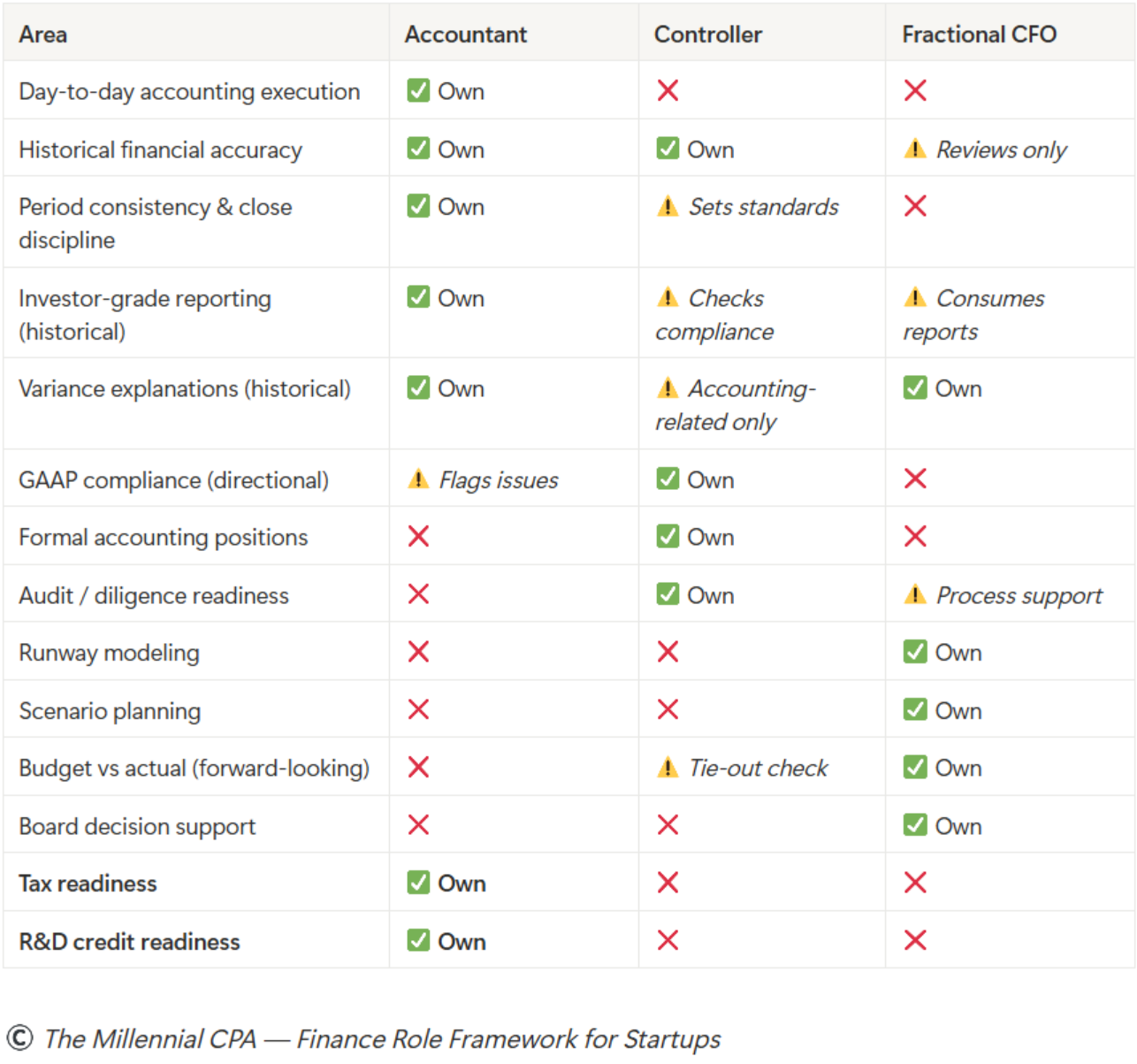
The chart below shows this at a glance. What follows is the practical meaning behind it.
Accountant (first, always)
For startups, the accountant is the foundation. This role owns the day-to-day accounting execution that everything else depends on: transaction accuracy, consistency across periods, and books that reflect what actually happened in the business.
A good startup accountant keeps the system clean and reliable — not just at year-end, but continuously. This includes tax readiness, coordination with tax filings, and ensuring the accounting data can be trusted when questions or decisions arise. For early-stage companies, this is where most financial stress is either resolved or quietly compounded.
Without solid accounting, higher-level roles are forced to work with incomplete or unstable information. That’s why accounting isn’t a junior step — it’s the prerequisite.
A quick note — accounting is often confused with bookkeeping, but bookkeeping alone typically stops at transaction recording. Startup accounting goes further — ensuring consistency, tax readiness, and decision-grade financials as the business grows.
Controller
Controllers exist to protect accounting integrity under scrutiny. Their focus isn’t daily execution, but defensibility: aligning treatments with GAAP (Generally Accepted Accounting Principles), documenting policy decisions, and preparing the company for audits, diligence, or investor review.
Controllers typically step in when questions become more technical — revenue treatment, leases, equity accounting, or audit readiness. Importantly, controllers do not run the books day to day. They rely on accurate accounting underneath them and focus on judgment, policy, and review rather than cleanup.
For startups, controller support becomes relevant as accounting complexity increases, not simply as revenue grows.
CFO
CFOs are forward-looking by design. Their role isn’t to fix accounting issues, but to help leadership make decisions using reliable financial information. This includes runway analysis, scenario planning, fundraising timing, and board-level decision support.
A CFO assumes accounting and reporting are already stable. When those foundations are shaky, CFO work becomes inefficient and often frustrating — strategic insight can’t compensate for unreliable inputs.
Together, these roles form a system — not a hierarchy — where each does a specific job. When boundaries are clear, finance becomes more predictable and easier to scale.
What you actually need — and when
Startup founders are often told they need a controller or a CFO long before the business is ready for either. That advice usually skips an important truth:
These roles solve different problems at different moments, and those moments don’t always align neatly with funding stages.
This section isn’t about titles or prestige. It’s about what kind of financial work the company actually needs right now — based on operational reality, not generic startup advice.
For most startups, the foundation is consistent:
A strong startup accountant owns day-to-day accounting, reporting consistency, and tax readiness. Just as importantly, a good accountant recognizes when new complexity is emerging — and knows when to bring in additional support rather than stretching beyond their lane.
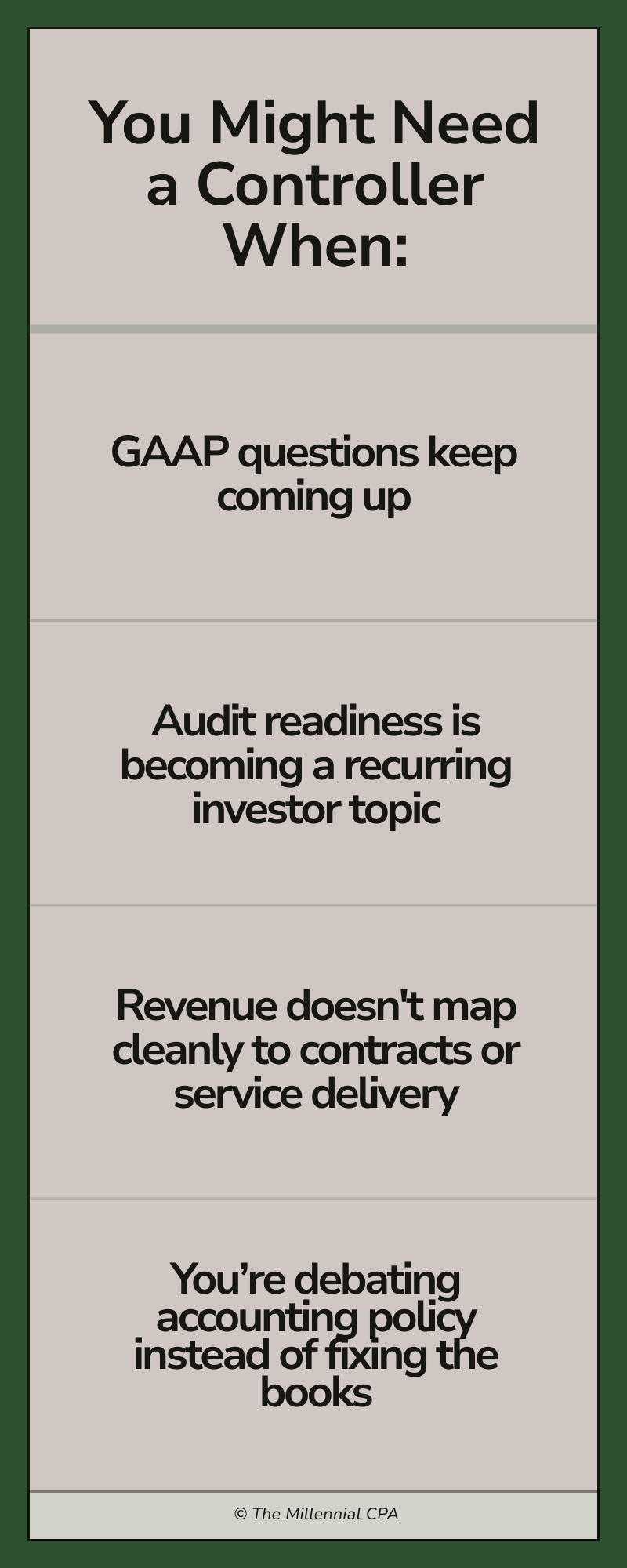
A controller becomes relevant when GAAP decisions, audit readiness, and accounting policy begin to matter. This often appears around late seed or Series A, but can surface earlier in regulated or complex businesses.
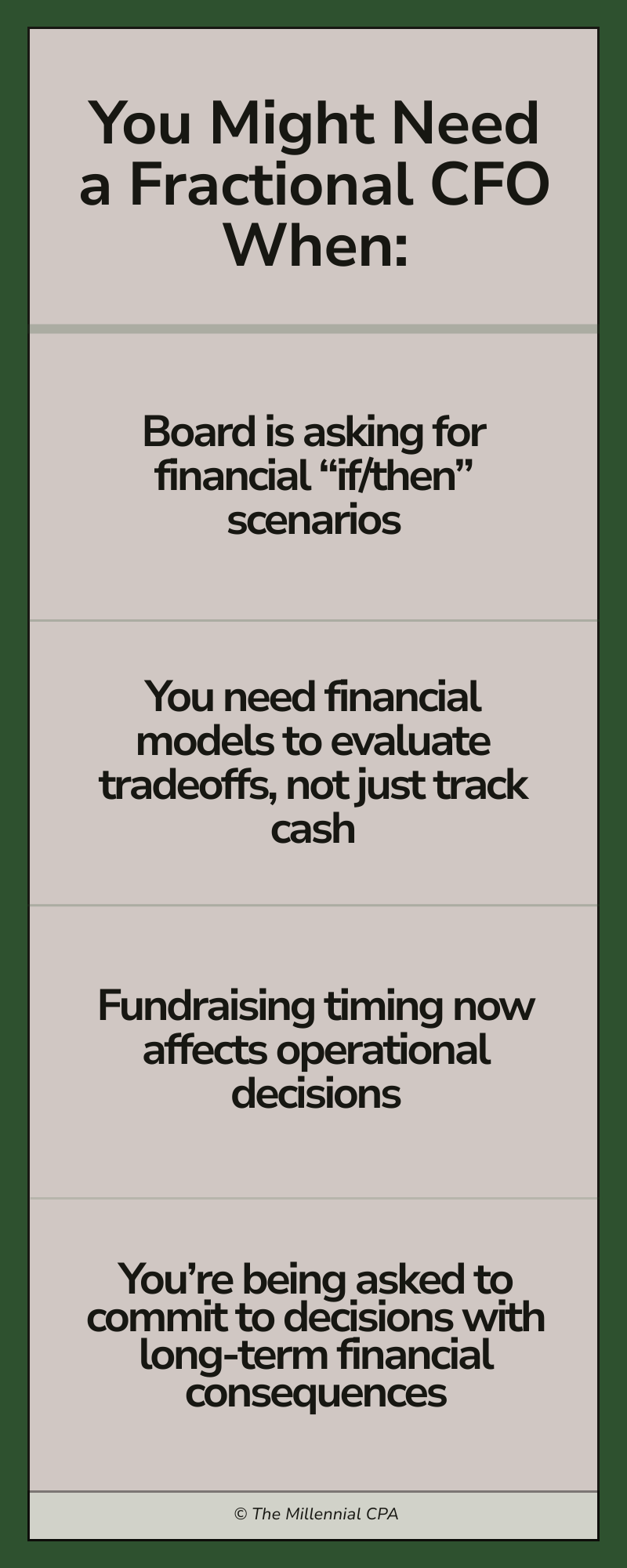
A fractional CFO becomes valuable once decisions require forward-looking modeling, tradeoff analysis, runway planning, and board-level context. While common at Series A or B, some seed-stage startups need this support earlier when decisions carry real financial consequences.
The cards below show the actual signals that founders experience as they move through these phases — without assuming every company needs every role at the same time, or in the same order.

Sequencing matters — but it isn’t rigid
This isn’t a hierarchy or a checklist.
Some seed-stage companies need fractional CFO input early.
Many early Series A companies only need strong accounting.
Some businesses temporarily need controller support and then step back.
The goal isn’t to hire ahead of need — it’s to stay operationally aligned as the business changes. When accounting is solid and escalation happens at the right moments, tax stays clean, reporting stays defensible, and decisions are easier to stand behind as the company grows.
Accounting is where tax and credits actually live
For startups, tax doesn’t sit off to the side. It lives inside the day-to-day accounting.
Every decision that affects taxable income — revenue timing, expense categorization, payroll treatment, capitalization, equity compensation — begins in the books. That’s why strong accounting isn’t just a prerequisite for tax compliance. It is the tax substrate.
A good startup accountant doesn’t “hand off” tax work once a year. They integrate it continuously. Clean, consistent accounting makes tax filings straightforward, defensible, and predictable — not reactive.
The same is true for startup tax credits, including the R&D credit. These credits aren’t discovered at filing time. They’re accounting-adjacent and tax-native. Eligibility depends on how activities are tracked, how costs are recorded, and how payroll and contractors are classified throughout the year.
That’s why credit readiness isn’t something you bolt on later. It’s evaluated continuously as part of normal accounting operations — long before a study is ever considered.
By owning accounting as a system, not a task list, tax stays integrated, credits stay clean, and nothing important gets deferred.
What we own — and when we bring in more help
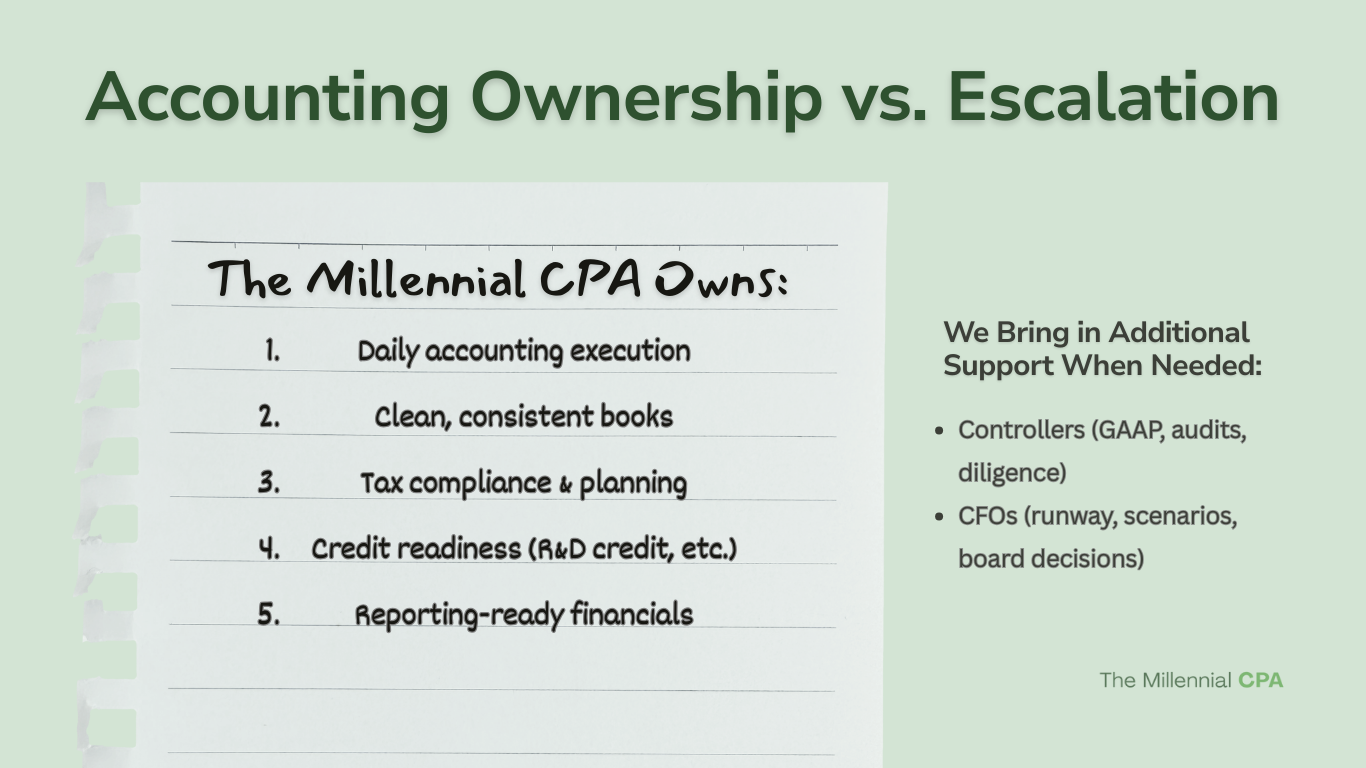
At The Millennial CPA, we’re deliberate about ownership.
In practice, most of the VC-backed companies we work with are product-led, engineering-heavy startups where R&D is a core part of the business. That reality shapes how we approach accounting, tax readiness, and credits from day one.
We fully own startup accounting: day-to-day execution, clean and consistent books, tax compliance and planning, credit readiness (including R&D), and financials that are ready to share with investors or a board. This foundation applies whether a company is pre-seed, seed, or early Series A.
What we don’t do is blur roles.
When work moves beyond accounting — into GAAP interpretation, audit or diligence preparation, complex revenue questions, runway modeling, or board-level scenario planning — we don’t pretend that’s still accounting. We bring in the right support when it’s genuinely needed.
That might mean controller support when accounting policy and audit readiness start to matter. It might mean fractional CFO involvement when decisions depend on forward-looking models, runway tradeoffs, or fundraising timing.
We don’t hold work we shouldn’t, and we don’t push founders to over-hire. Our job is to keep accounting solid, tax and credits integrated, and handoffs boring and clean when the business requires more support.
You don’t need everything at once — and most startups don’t
In practice, many startups benefit from an accountant with CPA and tax expertise — especially as complexity grows.
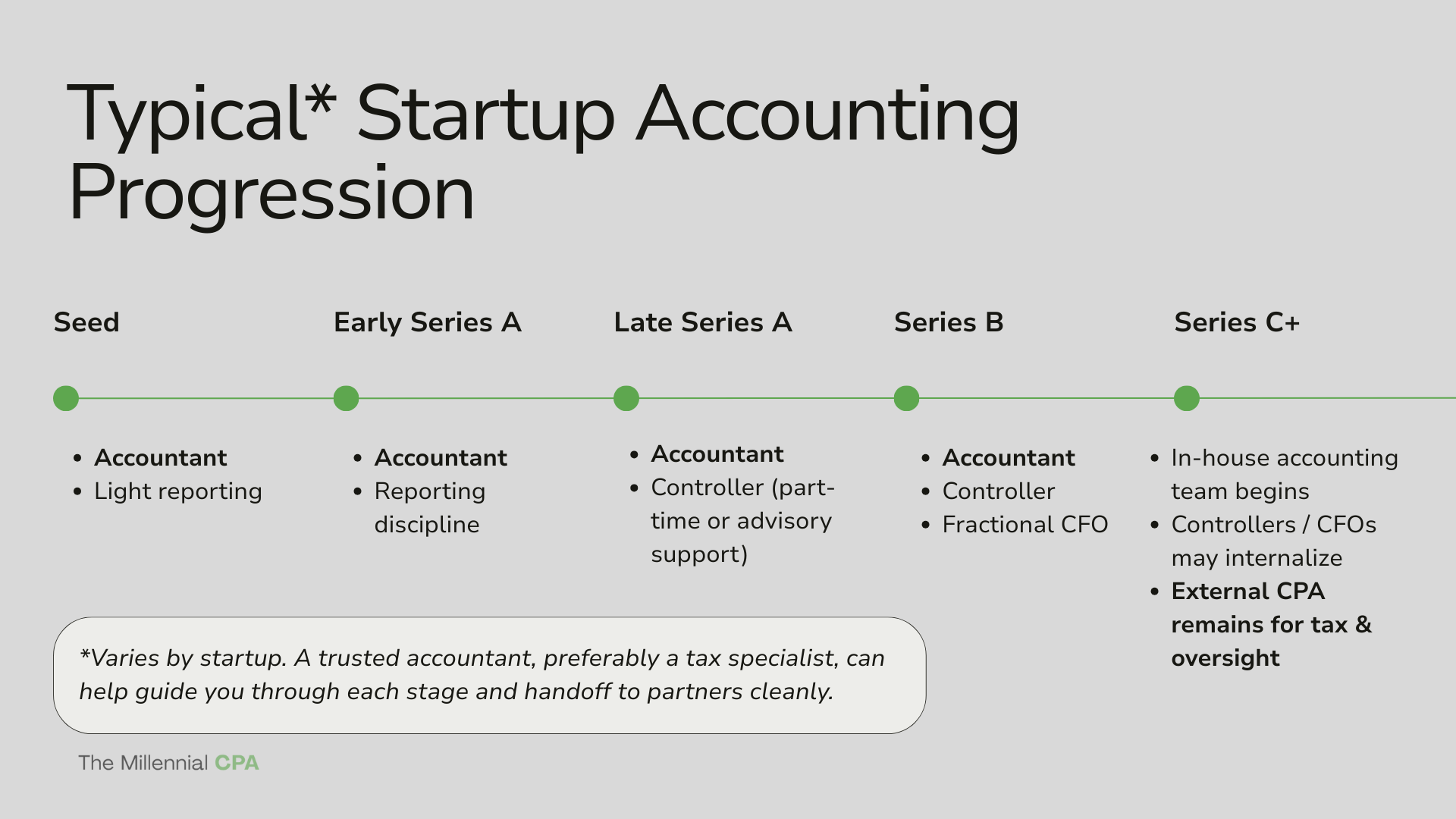
Most founders assume there’s a single “right” financial setup they’re supposed to reach quickly. In reality, startup accounting develops over time, and healthy companies add structure only when the business actually calls for it.
At the seed stage, the focus is simple: clean books and basic visibility. An accountant owns execution and keeps things accurate without unnecessary process.
As companies move into early Series A, reporting becomes more consistent and intentional. The work is still accounting — just with clearer cadence as the company grows.
By late Series A, complexity surfaces in specific areas. Revenue treatment, accounting policies, or diligence may require support from a part-time or advisory controller, layered on top of a stable accounting foundation.
At Series B, financial decisions shape the company’s future. Controllers and fractional CFOs may step in to support runway planning, scenario analysis, and board-level decisions — not to fix the books, but to work from them.
In Series C and beyond, finance teams often move in-house. Controllers and CFOs may internalize, while a strong external CPA typically remains involved for tax, credits, and oversight.
This path isn’t about moving faster. It’s about adding structure only when it’s earned — and keeping the financial function clear and manageable as the business grows.
Talk to the Millennial CPA about Accounting packages that support your total financial picture: